As the sun closed out the day, the fires on the altar of Ba’al brightened, energized by the darkness. The chanting of the crowd was punctuated by occasional screams as worshipers cut themselves. Sweat glistened on naked flesh in the firelight, and the pungent smell of blood and the smoke of burning was everywhere, forming a cloud that blanketed the amorphous mob of people.
The grotesque displays of sexuality to Ba’al and Ashterah no longer excited her. Now she found a subtler and riper pleasure in the public degradation and humiliation of the human form. She sat in her high seat, seeing all but observing nothing. Her mind was fixated on Jehoida. He was an irritant, like a grain of sand stuck in the soft flesh of an oyster. She visualized the spotless white priestly robes, the head covering, the breastplate, the gravitas of the chanted prayers, the ritual washings, the refusal to be reasonable. She hated all of it. Despised it.
Her mind was becoming clearer now. The wine had dissipated, allowing her natural cunning to sharpen and take shape. An idea was forming in the blackness of her soul. A symbolic and sacrilegious marriage between Yahweh and Ashterah. Yes, that was it. She'd force him, Jehoida, the high priest, upon pain of death, to be the ritual public participant at the harvest festival. The picture flooded her mind, spilling over into the blackness of her heart and overwhelming her in its brilliance. She looked out upon the throng of people in the firelight and smiled, content for the first time in months.
The rapping on his door abruptly ended the conversation with his wife Jehosheba. They had been, as they so often were, discussing Joash. Jehoida glanced at his wife, holding her gaze meaningfully for a few moments before rising from the table where he sat. Their dwelling was small and contained few furnishings, but it was enough. It took him only a moment to reach the door and open it. He started involuntarily when Mattan, high priest of Ba’al, stood framed in the doorway. His wraith-like body, silhouetted against the afternoon sky, seemed to absorb the sunlight, leaving only a shadow that writhed beneath his scarlet robe. His lip curled in a contemptuous sneer and if it was possible his eyes were even blacker than his shadowed face. A white skeletal hand emerged from his robe with a tightly rolled scroll, sealed with the royal insignia. “From one high priest to another,” he said, his voice hoarse and yet smooth simultaneously. Could Jehoida have seen through the hooded shadow he would have seen Mattan’s grotesque smile, which only appeared when inflicting suffering. “The queen requests your presence at the autumn festival.”
Jehoida stared at the scroll being held out to him, not willing to touch it. Finally, sensing that the only way to get rid of Mattan was to take it, he reached out and took it from his hand. He gasped in surprise when the scroll touched his hand. It seemed hot to the touch. He recoiled, but didn’t drop the neatly rolled paper. Mattan chuckled, bowed slightly, then turned and vanished. Jehoida closed his eyes, feeling dizzy. A moment later he reopened them and softly closed the door that he was still clinging too. He stood for a moment, not looking at the scroll in his hand. Master of the Universe, even the wicked you have made for the day of judgment. He turned to face Jehosheba, who was watching him intently, her brows knit together above questioning eyes. At seventy she was more beautiful than ever. Her flowing hair, silvery gray with hints of seasoned walnut still hidden within, framed her olive skin. Her brown eyes were deep and kind, but marked with the silent worry of a secret long-kept. Jehoida sat heavily at the table and broke the seal on the scroll. He read quickly and silently. When he reached the end he rose quickly and put the scroll into the small utility fire which was always kept burning, even in the warm months. The paper caught quickly, twisting and crackling as it burned. An acrid yellow smoke briefly filled the room. Jehoida coughed. The smoke stung his eyes and made them water, but quickly it was gone. He sat down before the table again, closed his eyes, and was silent, as if he’d fallen asleep. But then he began singing the Sh’ma quietly, rocking back and forth as he did. When he finished he opened his eyes and looked at his wife.
“That woman…” he began and stopped. How could he vocalize the wickedness of the scroll’s contents without defiling her and his home. Jehosheba’s face blanched, expecting the worst. She knew the blackness of Athaliah’s heart better than most. He continued, struggling to make the words come. “She is requiring my presence at the harvest festival of her gods.”
“Surely she knows Adonai forbids us to attend her idolatrous festivals,” Rehosheba answered, her voice thin and high.
“As a…chadesh.” He spat the word out as if it was a scorpion on his tongue.
Rehosheba wailed involuntarily and collapsed limp into her chair. Her cry brought Joash from the sleeping chamber, where he’d been resting. At seven years old he was already a head taller than other boys his age.
“Imma, are you okay?” he asked, worry in his voice.
“We have to take you back to the temple Ash,” Jehoida said softly. His eyes betrayed no fear or anxiety, only sorrow. “We’ll wait until it’s dark so you’re not seen.”
“Abba, why can’t I play outside in the sun like the other boys? Is the light from the evil one?”
“No child. Truly the light is sweet, and it is a pleasant thing to behold the sun. But your ears are not yet ready for your own story. There is much tragedy wrapped up in it. Much tragedy.” He closed his eyes and began reciting the evening prayers. Only the movement of his beard, long since grey, betrayed that the words came forth from him. He swayed back and forth, the intonation of the words matching his movement. Joash was used to seeing him recite the evening prayers, but tonight there was an unusual fervency. He stood behind his mother listening. She wept silently. He placed his hand upon her back and felt her shaking beneath her thin summer dress. Jehoida prayed on, unaware of his family’s presence. “Adonai, Creator and Master of the Universe. You have made all things for your good pleasure, even the wicked for the day of judgment, but why now, O God? Why now? The boy is so young. Can’t you wait just a little bit longer? Oh God, deliver us from the hand of this wicked Jezebel who never ceases to defile your people and your name. Your word, which cannot be broken, was given to our father David that never would he lack a man upon the throne, but this wicked woman is a shedder of innocent blood and even now seeks to destroy the seed, though she does it unknowingly. Deliver us O Lord our God. Deliver us!” His prayers reached a crescendo, back and forth he rocked, his voice modulating from soft and pleading, to questioning, to anger. Then abruptly he stopped and opened his eyes and he was back in the room with them. His face glowed in the dim interior light, his eyes radiant. “It is time,” he said simply.
Jehosheba looked at him, her eyes wet with tears. “But he’s so young. Surely not yet?” Joash had been the child of her old age, just like Isaac had been for Sarah, a blessing from God borne out of the ashes of evil. The thought of giving up the boy after seven short years troubled her almost as deeply as the letter from Mattan. Jehoida covered her clasped hands with one of his. “I am sure. Hashem has told me. But we must move carefully.”
“Abba, Imma, what’s happening?” Joash asked. “Are we in trouble?”
“No my child. Hashem hears. He will make everything right.”
The fall harvest festival was two weeks away. A month had slipped by since Mattan had delivered the fateful scroll to Jehoida. Since then he had heard nothing from the palace, but there was no mistaking the ominousness of that silence. His life would be won or lost in two weeks time, maybe less. The lot was cast.
Darkness tarried late in summer and Jehoida strained his eyes against the dusk, searching for movement. He was pressed against the side of his house, the white priestly robes luminous in the half-dark, like a harvest moon. The cicadas were out, but their song went unnoticed. His ears were straining for another sound. Finally the darkness was complete and he could see very little, but his hearing sharpened. Then he heard it, the sound of footsteps cautiously approaching. They stopped near the entrance. The newcomer hadn’t seen him. “Baruch hava b’shem Adonai,” he whispered into the darkness. There was a momentary silence in which his heart felt as though it would stop before he heard the answer he was waiting for, “Baruch hashem Adonai.” It was Azarriah, Jehoram’s son. He was the captain of the castle guard, as his father before him had also been.
“Azarriah, bless you for coming,” he said, still whispering.
“Of course. Is it well?”
“It is well.” As he answered additional footsteps sounded in the dark. Jehoida took Azariah by the arm and pulled him into the shadows. Not just one set, but two. The newcomers approached together. Both being new fathers they were commiserating about lack of sleep in the glad-hearted way that proud fathers do. It was Ishmael and Elishapat. Azarriah looked at Jehoida questioningly. Jehoida didn’t answer, but quickly pulled the newcomers into the shadows with him and exhorted them to silence. Moments later Maaserah showed up, followed lastly by Azariah son of Obed. Jehoida offered a silent prayer of thanksgiving to God and ushered the men into the outer chambers of the temple, then further inside, into his living quarters. Jehosheba, who he’d instructed to remain out of sight until his word, had left an oil lamp burning for them. He urged the men to sit, deferring their questioning stares with silence. Jehoida had served faithfully as the high priest longer than any of the captains had been alive and was to them a Moses like figure. Being men of action they were unaccustomed to being in the temple in such an intimate setting, and were restless. The oldest among them was Azarriah. He’d endured the reign of Ahaziah and the following seven years of Athalia. There was wisdom in his dark eyes, hard-earned through tragedy and suffering, and he seemed to sense the import of the situation more than his companions.
Jehoida stood in front of the small hearth fire, making him appear as a silhouette to the men seated in front of him. Now he would explain to them his strange request for the secret rendezvous.
“Men and brethren, thank you for coming,” he began. “I am a man nearer to the grave than to the day of my birth and will speak to you freely this night, though it may hasten the grave. I’ve known all of you since you suckled at your mothers breasts and you are as sons to me. As you know, the God of our fathers set David the King on the throne and swore a covenant with him that his seed would never fail until Messiah comes, may he come quickly. That wicked daughter of Jezebel who now occupies the throne is a serpent, and a bringer of death.”
The men were stony faced and deathly quiet. The atmosphere was tense. Athaliah was a cruel and unforgiving master, and quick to pronounce the sentence of death. To criticize her openly was reckless to any one who desired a long life. Though each of the men secretly despised her in his heart, to admit so publicly, being a captain of the guard, was unthinkable. After all, they had wives and children to care for.
Jehoida went on, sensing their trepidation. “I know your families. I see your fathers, your mothers, and your sisters worshiping in the house of the Lord. Know this then, the God of you, your families, and our father Abraham has not forgotten his people. The word of the Lord cannot be broken. He has preserved his inheritance.” Jehoida, who had begun quietly, now spoke with authority and the men, strong and brave soldiers, trembled in heart as if God himself spoke with them face to face. “Joash! Come forth!” Joash shyly emerged from the back room where he’d been sitting with Jehosheba. She wept silently as the voice of her husband reverberated from the outer chamber and it troubled Joash. She was a strong woman, but she’d been unusually troubled lately, and it seemed a harbinger of change to their quiet way of life. The thought of losing it, of losing her, made him tremble. She was the only mother he’d ever had.
He blinked as his eyes adjusted to the light, but didn’t recognize any of the men. Their leathery faces betrayed only hard hours spent in the sun and nothing else. Azarriah son of Jehoida, barely middle aged and yet the eldest among the guards, stared at the ruddy youth, and his eyes ignited. Then he did something that shook Joash to the core. He fell to his knees and bowed his face to the floor before him. Startled, Joash took a step backward and banged into the coal shovel kept hanging by the fire, which came loose and clattered to the floor.
“So the prophecies are true,” Azarriah said, as if to himself. Then he spoke directly to Joash, “My Lord, I served in the realm of your father, King Ahaziah, of whom you look an exact likeness. I remember the day of your birth and what I thought was the day of your death. Praise God who preserves the living and the dead and has not forgotten his people.” The other men, hearing these words, bowed before Joash also. Joash felt his head spinning, as if it had come loose from his neck. He looked at Jehoida imploringly. Jehoida smiled at him, just as he had on the day Joash had stumblingly repeated his first mitzvah.
“Sit my child,” he said, motioning to a wooden chair next to the fire. He placed his wizened, but strong hand softly on Joash’s shoulder, and it was like a burning coal through Joash’s linen shirt, radiating warmth throughout his entire body, like entering a warm bath during the winter season. When the warmth had enveloped him completely he no longer felt afraid of the men who bowed before him, but there was a peace and a longing in his heart, as if they were the brothers that he’d always wanted but had never known.
“The words that Azariah has spoken are true,” Jehoida said, facing Joash. “Ahaziah the king was your father. Your mother, whom you never knew, was Zibiah of Beer-Sheba, may she rest in peace. The woman who sits on the throne now is your grandmother.” Joash shuddered. He’d never laid eyes on the queen and had rarely heard her name spoken, but her wickedness was legendary in the land. “Jehosheba and I raised you as our own,” Jehoida went on, “though she is actually your aunt and not your mother.” He turned to the men, who also listened in wonder. “And now men of Judah, the Lord has declared to me that it is time for the throne to be restored. With what I have shown you this night you could easily have me put to death for treason. I am old and full of years so that matters little, but before you sits the true King and the word of the Lord cannot be broken. Athaliah’s evil must soon return upon her own head. Are you with the Lord you mighty men of valour?”
“Whether we live or die, we are with you to a man. May the name of our God be praised from the throne in our lifetime,” said Azariah, and all the men with him said likewise.
The day of the harvest festival was only a week away. An excited hum ran through the city like an electric current. The Baal worshipers prepared for the festival of the high sacrifice, while the worshipers of God began to build their Sukkahs for the festival of booths, and overshadowing it all was the constant work of reaping the harvests. Barley and wheat were being piled in sheaves and prepared for threshing throughout the fields surrounding the city. Athaliah was also preparing. Her heart had burned against Jehoida since she’d delivered the decree against him, and she cherished thoughts of humiliation about to be brought on him. His degradation would embolden the Ba’alim against this God that the people so stubbornly clung to. If Jehoida didn’t die during the worship festivities she’d provided Mattan with a long thin blade to put through his heart after the chadesh were finished with him. The fire piles were already stacked high with cedar and his body would be cast upon them at their hottest point - a thanksgiving offering to Ba’al who had favored them this year with fertile crops.
When the day of the festival arrived the air was thick with anticipation. Always a joyous time, this year was pregnant with expectation. Athalia had made little effort to keep her plans a secret, and many of her closest counselors were eager to see Jehoida, who refused to participate in or attend anything related to Ba’al or Asherah, brought low publicly. Had Athaliah not been consumed with the bitterness of her heart however, she may have noticed another undercurrent of emotion in the buzz, but she didn’t. All morning her eunuchs fussed over her, dressing her in scarlet linen robes brought in from the seaports of Tyre and rubbing oils of frankincense into her papery skin. Her face was then painted, first with a white lustre, then with dark eyebrows and shadowy lids, creating twin pools of darkness around the eyes that could pull a person down to Sheol. By mid-day she was fully costumed and sitting alone in the palace window, watching the stir of the city below and waiting.
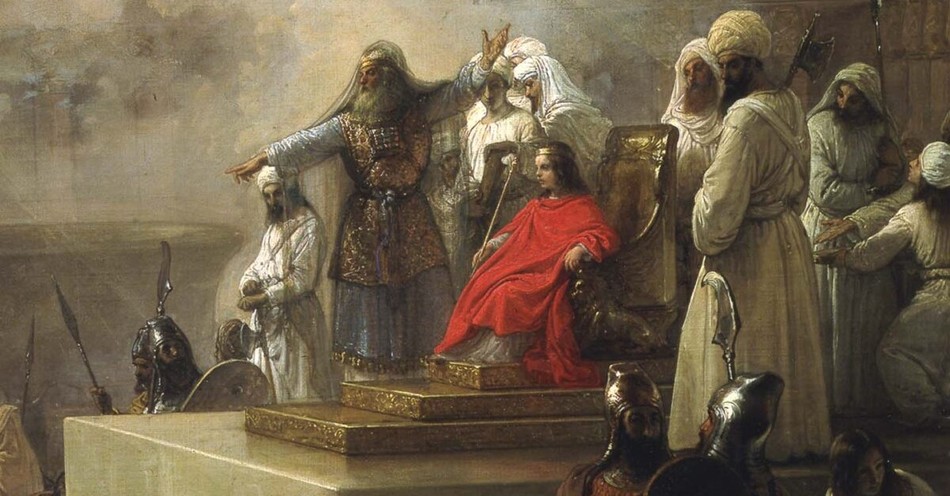
Meanwhile, inside the temple Joash had been brought out of the high priest’s inner chambers and set before the altar of sacrifice on an elaborately adorned chair that Jehoida’s helpers had set upon a hastily constructed dais. He also was draped in a scarlet robe, though it was much too large for him and dragged on the ground when he walked. All around him were Levites, grim faced and armed with the weapons of war that David’s army had used generations ago. A row of priests stood on either side of the walkway leading from the door of the temple to the altar, each with a shofar in hand and a sword strapped to his waist.
Earlier in the day he’d also seen the men from the secret night meeting speaking earnestly with Jehoida, but they’d all departed. He felt safer when they were around. Sweat trickled down his back and from under his thick brown hair. He fidgeted in the seat, wondering how long this was going to take. Jehoida had rehearsed it with him last night, everything that was supposed to happen, but it was now jumbled in his head. The day had been a multitude of people coming and going, hushed conversations, and last minute preparations. The familiar and sickly sweet smell of dried blood and stale ashes wafted towards him from the altar. He had always expected he’d be the next high priest.
After some time Jehoida rejoined him. His brow was creased and his eyes solemn. “Strength my son,” he said, perhaps to himself. “Though we die, the Lord will prevail.” He held a shofar in his hand and raised it ceremoniously to his lips. There was a momentary silence in the heavens, then he blew a deep reverberating blast, followed by a series of piercing short blasts. With that the priests on either side of the walkway raised their shofars as well and mimicked the call. The sound wakened something primal deep within Joash’s bosom and he remembered, but not from himself, bearded kings clad in sweaty armor bloodied, but victorious on fields of battle, thick with the smoke of war, and courageous against mighty men of valor.
Athaliah heard the horns from her window seat in the palace. Distracted by her own thoughts and the bustle of the day she paid no attention at first, but the reverberating blasts wouldn’t stop. Her priests didn’t use the shofar to present the festival and these weren’t horns of war. What was it? She looked down from her window, annoyed, her thinly trimmed eyebrows knit and her painted lips pursed. The ruckus was coming from the temple. She clicked her tongue against the roof of her month and turned towards the door in a single decisive motion. Someone would pay for this. Quickly she glided across the expansive room, and pushed open the heavy oak door to demand the door guard summon Ishmael, captain of the royal palace guard, but the door guard wasn’t at his post. Athaliah’s mouth dropped open and she was left speechless for a moment. Leaving the queen unguarded was punishable by death. She screeched in rage for the captain of the castle guard, “ISHMAEL!” Only the echo of her own voice answered her. Holding up her linen skirts she rushed down the corridor. Her feet were bare against the cool stone floor, but she took no notice. Murder was in her heart. The guard post at the top of the upper staircase was also empty. A primal scream erupted from her bosom. “ISHMAEL!” she screamed again. Her skin was flushed as crimson as the rage the clouded her vision, and every nerve in her body was set ablaze. From outside she heard again the blowing of the horns.
With a nimbleness that surpassed her age she flew down the stone stairs with no more thought of her linen skirts which now dragged on the floor behind her. The palace seemed to be deserted. Finally reaching the door to the outside she burst forth. Here were the guards, lined up neatly against the exterior of a the castle, forming a fence of emotionless warriors. Her eyes quickly scanned their faces, looking for the captain, but she didn’t see him. Turning to the soldier closest to the entry she seized him by his tunic and shook him. “Where is Ishmael,” she said, her voice low and laden with unspoken threats. Spittle flew from her mouth as she talked, but the soldier made no acknowledgment of her or that he was being shaken. His eyes were focused on a point beyond her, as if she didn’t exist. “I’ll have you killed for this!” she said, giving him a last violent shove into the wall. She scanned the faces of the soldiers again, but none returned her gaze. Behind her the horns blew again. She turned and ran across the dusty streets towards the temple. The horns grew louder. Outside of the temple gate there was a multitude of soldiers, all suited for war. She stormed through the outer gate, crossed the courtyard, and entered into the first temple chamber. Her eyes took a moment to adjust to to the light, but then in a glance she took in the row of priests, each holding a shofar and each outfitted with a sword. In front of the altar was a cluster of priests, selected for strength. From the midst of the men Jehoida emerged and looked directly into those venomous eyes.
Athalia’s face twisted into a cruel sneer and a rasping bark of a laugh escaped from her lips. “Jehoida” she said with disdain, pointing a bony finger at him. “I should have known. I’ll enjoy watching you die tonight.
“Guards!” she called. Her voice had resumed its authority, all rage now suppressed. No one answered her or looked at her. “Guards!” she called again, louder. Still there was silence.
Jehoida then raised the rams horn to his lips once more and blew a final blast that shook the temple walls. “May the Lord God of Israel, blessed be His name, show now that His promises never fail. Long live the true King, the seed of David, Joash the son of Azariah!”
The line of priests on either side of Athaliah lifted their voices in unison. “Long live King Joash!” The priests who stood in front of the altar moved to the sides like water flowing down a hill and behind them, for the first time in eight years Athaliah saw the face of her grandson, and all the nagging doubts came rushing upon her like a flood. She had forgotten one! She’d sensed it ever since she’d taken the throne. A hawk-like shriek started deep in her soul and gathered strength until her head snapped back, making way for it to escape in a demonic eruption of sound. “Treason! Treason! Treason!” she yelled, charging the makeshift throne, ready to kill Joash with her bare hands. All rational thought had departed from her and a deathly rage drove her to destruction. In an instant she was restrained by a multitude of armed priests.
“Take her outside the house of the Lord and show her the same mercy she showed her grandchildren.” Jehoida said calmly. He put his hand on Joash’s shoulder, steadying both of them. Joash watched as his grandmother, whom he had never known, was dragged away, cursing and screaming unintelligibly. Any semblance of humanity had departed from her and her eyes overflowed with hatred towards him. As she vanished from his sight her raucous screaming became more and more distant until it ceased abruptly, never to be heard again. The peoples voices rose and broke like a wave, rejoicing and shouting. He heard his name over and over, then the shofars all around, the blasts coming from all directions. His head spun and he was thankful for the chair in which he sat. “Courage my son,” Jehoida said, looking beyond the temple walls, as if into realms unseen. Joash understood little, but knew that as long as Jehoida was near things would be okay.